
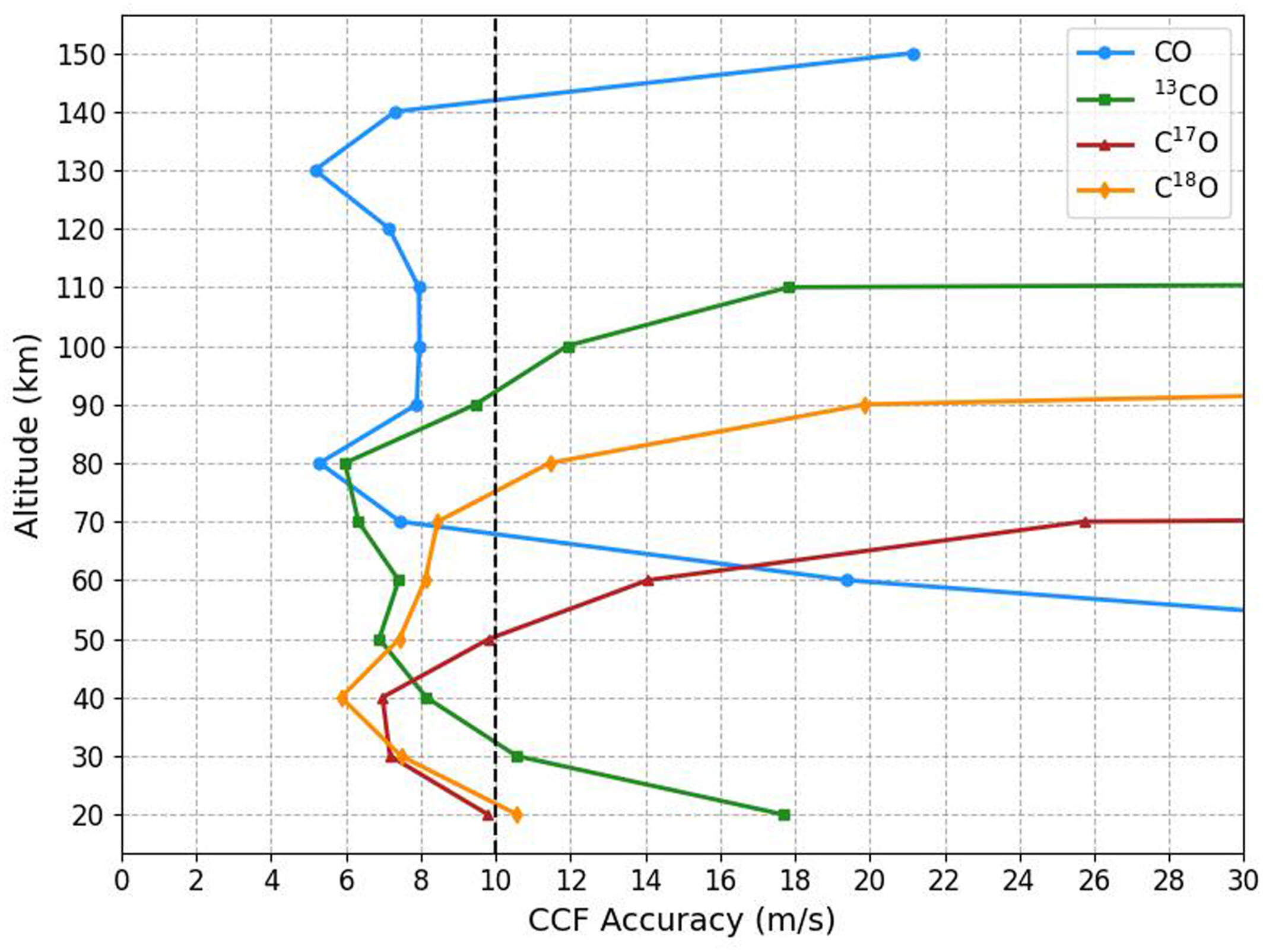
Members of our group have developed a computationally efficient cross-correlation method to retrieve atmospheric winds from microwave limb sounder measurements and tested it using simulated observations of a generic instrument. For the baseline instrument configuration, simulations yield wind accuracy better than 10 m/s between roughly 20 and 150 km.
The advantages and operational potential are several, among them we stress low computational burden suitable for full spatial and temporal characterization of atmospheric variability without reliance on external data sources, and the technique is adaptable to other instrument designs and could operate as a fast, near-real-time wind retrieval method for future orbital microwave limb sounders.
An operational microwave limb sounder in Martian orbit, using this method, could for the first time deliver widespread, accurate observational constraints on Mars’ global atmospheric circulation (see Fig. 1)
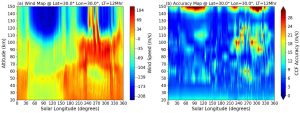
Fig. 1: Zonal wind profiles directly simulated from the Mars-Planetary Circulation Model (a), and derived accuracy from the cross-correlation function using the CO and C18O line combination (b) throughout an entire Martian year at 12 Martian hours of local time and 30.0 North Latitude, 30.0 East Longitude. A grid of 670 Solar Longitude values, with 0.51 steps, was used to ensure complete annual variability. Regarding the accuracy map, the blue color indicates accuracy better than 10 m/s.
However, some limitations and mitigation strategies are present, such as line broadening at lower altitudes reduces displacement detectability; employing weaker lines (minor CO isotopologues) helps recover lower-altitude winds; adding a third line improves the middle-altitude (40-80 km) retrievals, etc.
The accuracy in the measurement of Mars’ winds can achieve depends strongly on spectral resolution: 100–200 kHz is determined as the he best tradeoff between resolving spectral line shifts (Doppler sensitivity) and noise.
– The approach could also support retrievals of temperature and CO abundance; detailed investigations of multi-parameter retrievals and multi-line combinations will be pursued in follow-up work to further expand the scientific return of microwave limb sounders for Mars.
The cross-correlation retrieval presented in Jurado-Fortuna et al. (2026) offers a fast, adaptable path to operational wind measurements from orbit, with strong potential to transform observational knowledge of Martian atmospheric dynamics, CO abundance and temperature and support future exploration.