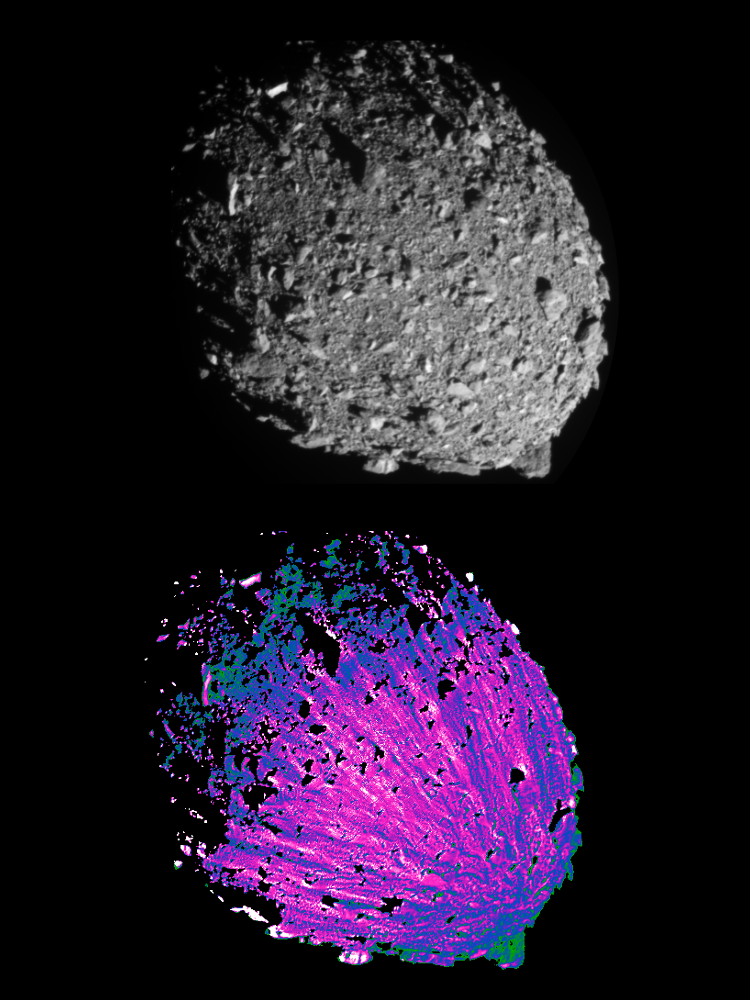
Binary asteroid systems are relatively common among near-Earth objects, with about 15% of asteroids hosting small moons. A study co-led by a member of the SCITECHSS group revealed that these systems are more dynamic than previously thought, exchanging rocks and dust through slow, low-velocity impacts that gradually reshape their surfaces over millions of years. Using images captured by NASA’s Double Asteroid Redirection Test (DART) spacecraft shortly before its 2022 impact with the asteroid moon Dimorphos, the team identified faint fan-shaped streaks on the moon’s surface. These features represent the first direct visual evidence of material naturally traveling between the primary asteroid Didymos and its satellite.
The Team determined that these streaks were produced by slow-moving debris—described as “cosmic snowballs”—that had been ejected from Didymos and later landed on Dimorphos. Careful image processing was required to reveal the features, as they were initially hidden by shadows and lighting artifacts in the spacecraft images. By mapping the streaks to a specific region on the moon and refining three-dimensional models of Dimorphos, the team confirmed that the patterns were real geological features rather than imaging effects. Their analysis also provided the first direct visual confirmation of the Yarkovsky-O’Keefe-Radzievskii-Paddack (YORP) effect, a process in which sunlight gradually increases the rotation rate of small asteroids until surface material is ejected, sometimes forming a secondary body.
Further calculations showed that the debris left Didymos at extremely low speeds—about 30.7 centimeters per second, slower than typical human walking speed—allowing the particles to settle gently on Dimorphos and form distinctive ray-like deposits rather than impact craters. Laboratory experiments and computer simulations reproduced these fan-shaped patterns, demonstrating that boulders on the asteroid’s surface guide the distribution of incoming material. The results indicate that binary asteroid systems evolve through continuous material exchange and surface reshaping. Future observations from the European Space Agency’s Hera mission, scheduled to arrive at Didymos in December 2026, may confirm whether these deposits survived the DART impact and could reveal new features created by debris from the collision, improving models of asteroid evolution and planetary defense.
The paper, “Evidence of Recent Material Transport within a Binary Asteroid System,” has been published on March 6, 2026 in The Planetary Science Journal.