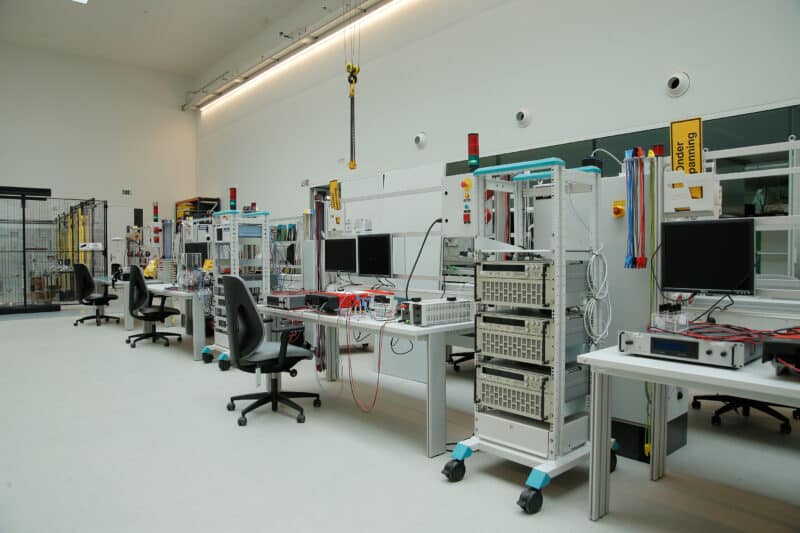
The Science and Technology for Solar System Exploration Group (SCITECHSS) operates a state-of-the-art laboratory that supports its cutting-edge research and development activities. The laboratory is equipped with advanced facilities and instruments designed to simulate space environments, test and calibrate space-bound instruments, and develop new technologies for solar system exploration. Below is an overview of the key facilities and capabilities of the SCITECHSS laboratory:
1. Simulation Facilities
- Thermal Vacuum Chambers
- Simulate the vacuum and extreme temperature conditions of space to test the durability and functionality of spacecraft components and instruments.
- Radiation Simulation
- Facilities equipped with radiation sources to simulate the space radiation environment and test the resilience of electronics and materials against radiation damage.
2. Instrumentation and Sensor Development
- Optical and Imaging Laboratories
- Facilities for the development and testing of high-resolution cameras and spectrometers, including clean rooms to prevent contamination of sensitive optical components.
- Laser Development Lab
- Equipped with advanced laser systems for developing and testing laser altimeters and other laser-based measurement instruments.
3. Material Science and Thermal Protection
- Material Testing Lab
- Facilities for testing the mechanical properties and radiation resistance of materials used in spacecraft construction.
- Thermal Testing Facilities
- Labs equipped with thermal testing setups to study and develop thermal protection systems for spacecraft and instruments.
4. Remote Sensing and Radar Technology
- Radar and Remote Sensing Lab
- Facilities for the development and calibration of radar systems, including synthetic aperture radar (SAR) and subsurface sounding radars.
- Signal Processing Lab
- Equipped with high-performance computing resources for developing and testing signal processing algorithms for remote sensing data.
5. Autonomous Systems and AI
- Robotics and Autonomous Systems Lab
- Facilities for developing and testing autonomous navigation and control systems for planetary rovers and spacecraft. Includes simulated terrain environments for real-world testing of robotic systems.
- AI and Machine Learning Lab
- Resources for developing and training AI algorithms for autonomous decision-making, data analysis, and mission planning.
6. Integration and Testing Facilities
- Systems Integration Lab
- Facilities for integrating various scientific instruments into spacecraft platforms and ensuring their compatibility and performance.
- Environmental Testing Chambers
- Simulate a range of environmental conditions, including vibration and acoustic testing, to ensure that spacecraft components can withstand the stresses of launch and space operations.
7. Data Analysis and Mission Planning
- Mission Operations Center
- Equipped with real-time data processing and analysis tools to support ongoing space missions, providing a hub for mission control and data interpretation.
- Simulation and Modeling Lab
- Facilities for simulating spacecraft trajectories, planetary environments, and mission scenarios to aid in planning and risk assessment.
8. Collaborative Research and Development
- Collaborative Workspaces
- Designed to facilitate interdisciplinary collaboration among scientists, engineers, and external partners from space agencies, universities, and research institutions.
- Virtual Reality and Visualization Lab
- Advanced visualization tools, including virtual reality setups, to aid in the interpretation of complex data and the design of mission scenarios.
The SCITECHSS laboratory is integral to the group’s research efforts, providing the necessary infrastructure to develop, test, and validate the technologies required for successful solar system exploration missions.