
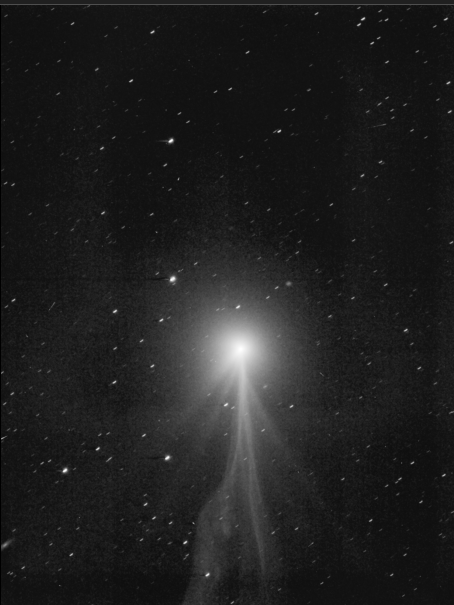
On 1 July 2025, the interstellar comet 3I/ATLAS was discovered. Images obtained at a heliocentric distance of 4.5 astronomical units (AU) — about 673 million kilometres from the Sun — already showed clear evidence of cometary activity. This object represents the third cometary body originating from another planetary system that has been observed visiting our Solar System.
Observational campaigns from ground-based observatories and space telescopes were carried out until early October 2025, when the comet’s small apparent angular separation from the Sun prevented further data acquisition. The interstellar object 3I/ATLAS then continued its journey toward perihelion, which occurred on 30 October 2025, at a distance of 1.36 AU from the Sun (about 203 million kilometres), between the orbits of Earth and Mars.
At that time, ESA’s JUICE spacecraft, currently en route to the Jupiter system, happened to be in a particularly favourable position in space to observe the interstellar visitor. Given the exceptional nature of this event, observation campaigns targeting 3I/ATLAS were coordinated by ESA’s European Space Operations Centre (ESOC) and the European Space Astronomy Centre (ESAC), in collaboration with the teams of several onboard instruments.
One of these instruments, the JANUS camera, which includes researchers from the SCITECHSS group at Institute of Astrophysics of Andalusia (IAA-CSIC) and the University of the Basque Country (EHU), acquired observations of 3I/ATLAS between 5 and 25 November 2025. During this period, JANUS obtained more than 120 images using seven filters covering the spectral range from 380 to 1015 nanometres. These data were transmitted to Earth on 19 February, when the JUICE–Earth geometry was favourable for data downlink.
The images reveal intense activity from the object near perihelion. They show an extended coma, a prominent dust tail, and a long ion tail displaying structures produced by the ionization of water, the dominant gaseous component in the cometary coma. The observations also reveal sunward-directed jets, fountain-like structures (see Fig. 1) associated with active regions on the nucleus, and features indicating disconnection events in the dust tail, triggered by the interaction of the comet with strong solar disturbances.
In the coming weeks, the JANUS science team will conduct a detailed analysis of the image dataset, focusing on the morphological structures, photometric properties, and the evolution of the coma and tail on short and intermediate timescales.
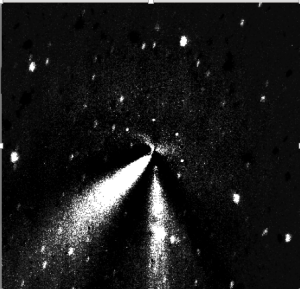
Fig.1 Processed image of 3I/ATLAS highlighting structures present in its coma and tails. The image was acquired on 5 November 2025 with an exposure time of 150 s. At the time of observation, the distance between JUICE and the interstellar comet was 0.43 AU. The field of view shown covers 5 10⁵ × 5 10⁵ km, with the cometary nucleus located at the centre of the image.